


Research
Conducting polymers such as PEDOT can carry both electrons and ions, which makes them unusually good at talking to the body. Our work is about depositing them reliably, characterising them electrochemically, and keeping them stable once they leave the beaker.
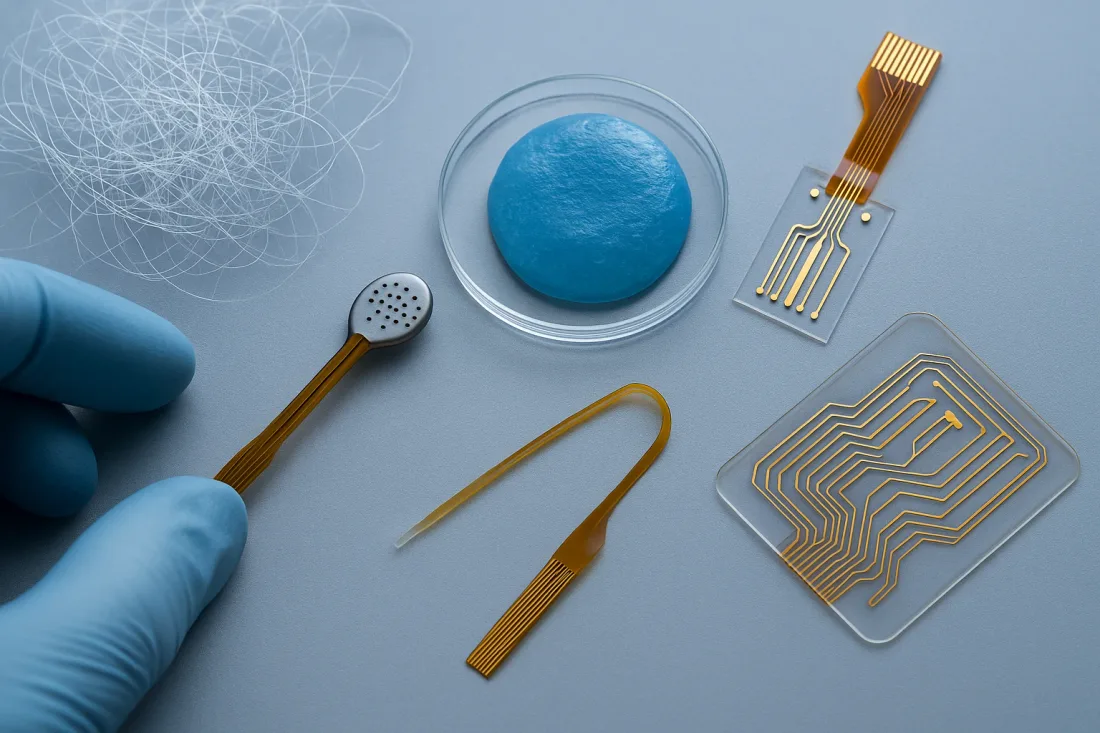
Materials synthesis
Natural and synthetic polymers, above all conducting ones, made in whatever form the application needs — from solid coatings to hydrogels and nanofibres.
We synthesise and process a wide range of functional materials, with conducting polymers such as PEDOT and polypyrrole at the centre. The same chemistry can become a solid coating on metal, a soft hydrogel or a nanofibre mat, so the material can be matched to the tissue and the device it is meant for.
Electrochemical and electrical characterisation
Our speciality: complete electrochemical characterisation, including under tissue-like conditions, and conductivity measurements on soft materials with set-ups we build ourselves.
Electrochemistry is what the lab does best. We characterise materials with the full range of electrochemical methods, including under conditions that simulate the environment of living tissue. We also measure electrical conductivity, soft materials included, and design and build our own set-ups for those measurements.
Controlled release and degradation
Systems that release drugs, ions and other species, and studies of how materials degrade, followed by spectrophotometry and electrochemistry together.
We build and study systems that release drugs, ions or other species at a controlled rate, and we follow how materials degrade over time. Spectrophotometry tells us what is released and how much, and electrochemistry tells us what is happening to the material while it does.
Bio-interface applications
Where the materials end up: flexible electronics, cardiovascular stents, neural electrodes for brain–machine interfaces, and soft electrodes for hydrogen production.
Our materials are developed with a use in mind, and most of those uses are bio-interfaces: flexible electronic systems, drug-carrying coatings for cobalt–chromium cardiovascular stents, and neural electrodes for brain–machine interfaces. The same soft electrode materials also work outside the body, as electrodes for hydrogen production.
The work above runs inside concrete, funded projects — see Projectsfor what is going on right now, or Publications for the full record.